01
A product you can actually deliver
Chosen, not developed — something that passes the Tuesday test and ships this week, so months don't disappear into 'getting ready.'
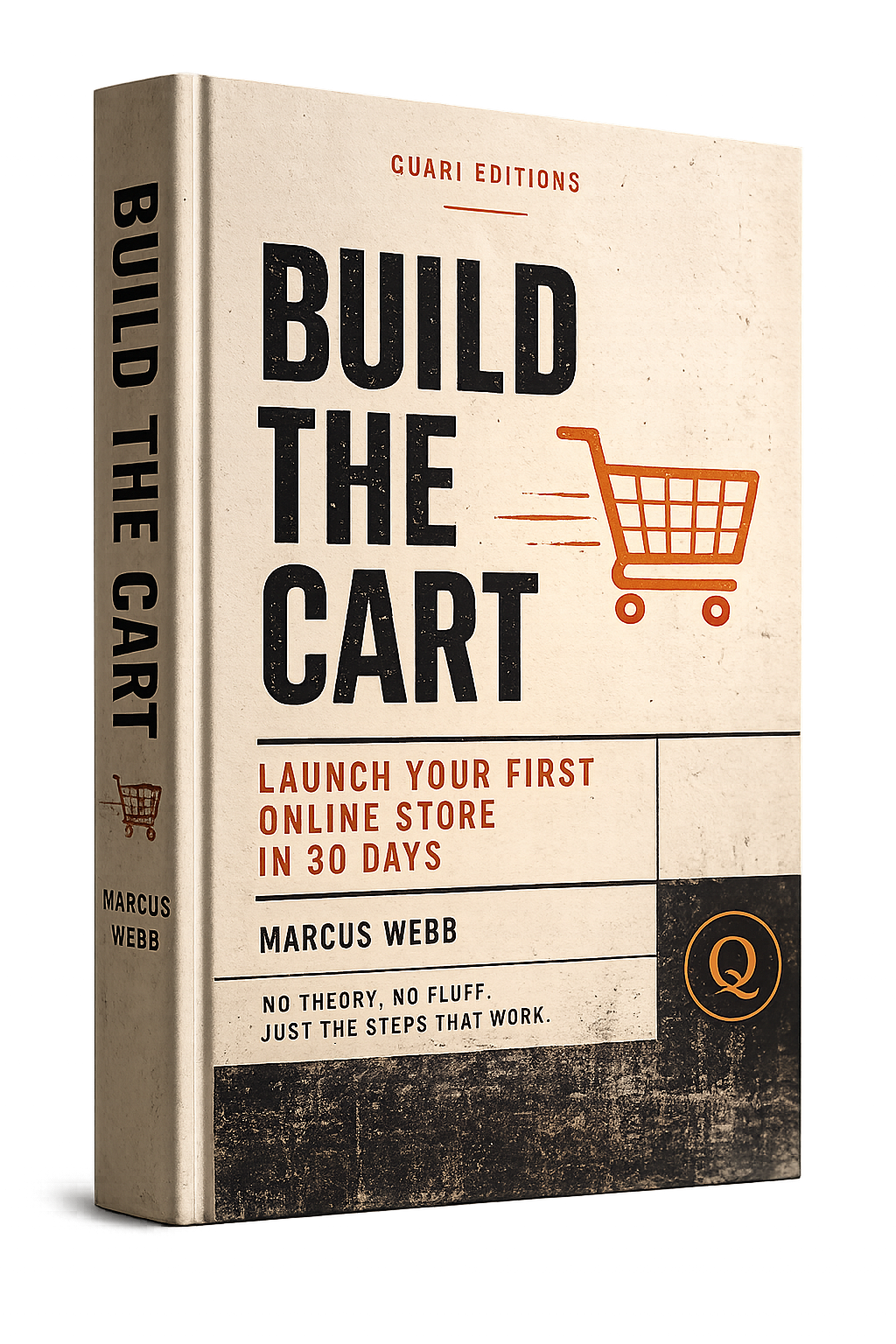
SKU · build-the-cartMarcus Webb · Quari Editions
In thirty days — nights and weekends, no investors, no warehouse — you choose something to sell, stand up a real storefront, and get it in front of your first hundred buyers.

Better product, better logo, better moment. Build the Cart takes that excuse away. The constraint isn’t a limitation — thirty days is the only thing that reliably beats perfectionism. When you have unlimited time, you polish. When you have a deadline, you ship.
Not theory. Not a mood board. The three things that prove this is a business and not a daydream.
Chosen, not developed — something that passes the Tuesday test and ships this week, so months don't disappear into 'getting ready.'
A real cart a person who's never met you can check out of in a weekend. The place to sell, standing and live.
The only people who can tell you the truth about whether this works, with real money on the table.
No padding. Each chapter is a move you make, in order, toward the first sale.
The most expensive decision you’ll make isn’t your logo, your platform, or your pricing. It’s what you choose to sell. And most people get it wrong in the same way: they pick something they love instead of something they can ship.
Let me give you the test I use now, after killing seven stores by ignoring it. I call it the Tuesday test: if someone ordered this on Tuesday morning, could I get it to them by the following Tuesday? Not in theory. In reality. With the supplier you actually have, the inventory you can actually get, the time you actually have after your day job.
If the answer is no, the idea isn’t wrong — it’s just early. You’ve picked something that requires a business to already exist before it can begin. Your first product exists to teach you how to run a store at all. Pick the version that lets you learn fastest.
“I'd been 'about to launch' for two years. I read this on a Sunday and had a live store by the next weekend. The Tuesday test alone was worth it.”
“No passive-income fantasy, no fluff. Just the boring middle nobody else writes about. It got me to an actual order.”
“I picked my clearest idea instead of my best one, exactly like he says. That’s the only reason it shipped.”
“The deadline did what willpower never could. Thirty days, version one, embarrassing and live. Then it sold.”
One-time. Yours forever. If it doesn’t get you moving, it’s the cheapest lesson you’ll buy this year.
No money you don’t have. The whole method is built so your first product is chosen from what already exists — a bundle, a digital thing you’ve half-made, or one simple item with a real supplier. No warehouse, no investors.
Yes — that’s the assumption the book starts from. Chapter V is entirely about where your first hundred visitors come from when nobody knows your name yet.
Nights and weekends. The thirty days assumes a few free evenings, not that you quit anything. The deadline is what makes the limited time work instead of stalling you.
Chapter II is the whole answer: the Tuesday test and three categories of product you can choose — not develop — this week. You’ll have your one sentence before you touch a website.
No. Marcus has launched eleven stores and killed seven. This is the unglamorous, repeatable middle nobody posts about — the steps that end in a real order, not a fantasy.
The complete book — all eight chapters — delivered instantly. Read it tonight, start day one tomorrow.
Stop polishing the part that isn’t the start. Pick something, stand up the cart, and let real buyers tell you the truth.
Demo storefront — not a real purchase