
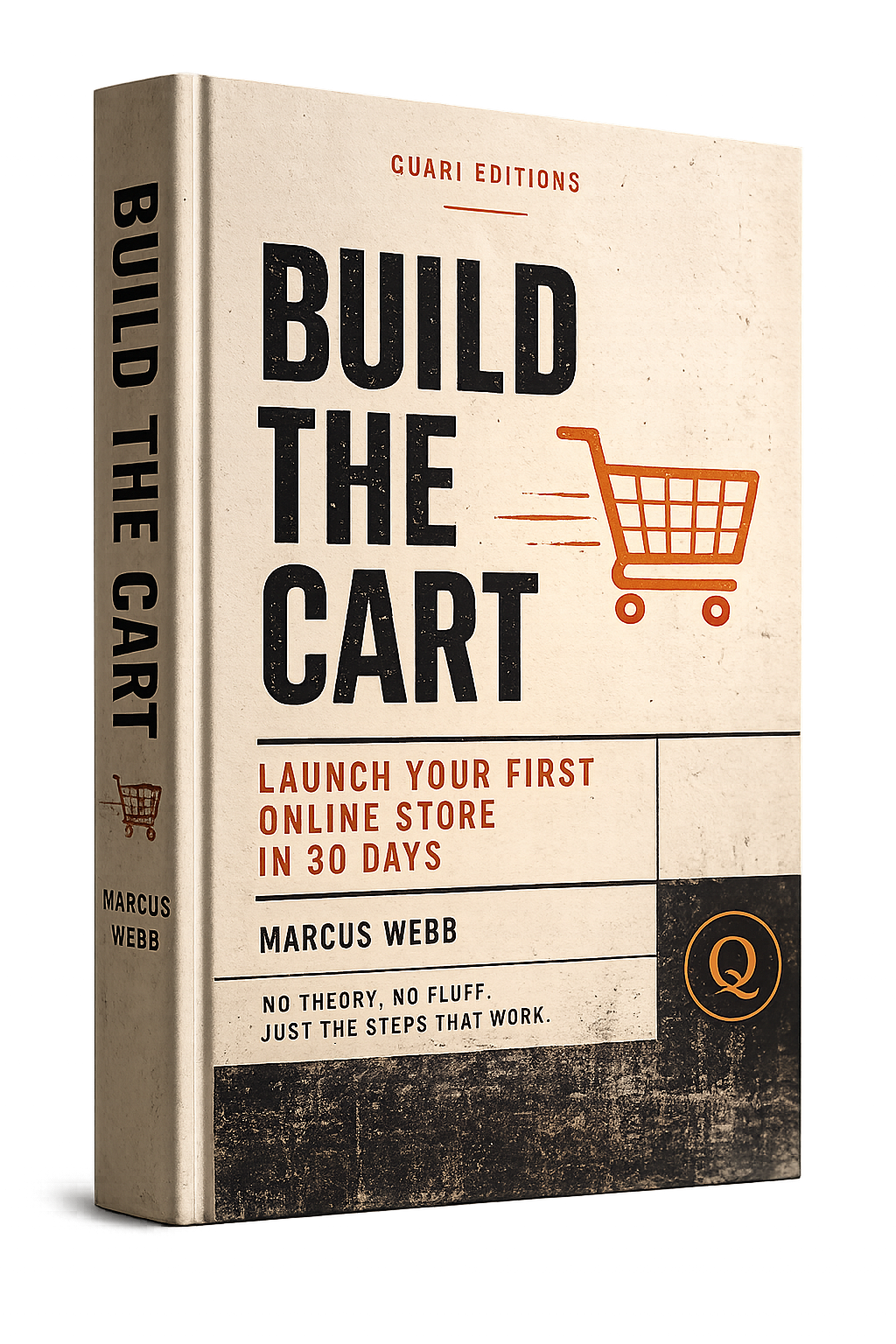
E-Commerce
Build the Cart
Launch your first online store in 30 days
Marcus Webb · Quari Editions · First Edition
You don't have a store yet for one reason: you're waiting to be ready. Better product, better logo, better moment. Build the Cart takes that excuse away. In thirty days — nights and weekends, no investors, no warehouse — you'll choose something to sell, stand up a real storefront, and get it in front of your first hundred buyers. No theory. No "passive income" fantasy. Just the unglamorous, repeatable steps that turn an idea into an order notification on your phone. The hardest part of a business is the part before it exists. This book is about getting past that part, fast.
Sample reading
Introduction
Most people who want to start a store never start a store. Not because they can't — because they're stuck in the part before the start, the part that feels like work but isn't. Researching. Comparing platforms. Watching one more video. Designing a logo for a company that has never sold a single thing.
I did all of that. For my first store, I spent six weeks "getting ready" and zero dollars in sales. For my fourth — the first one that actually worked — I spent a weekend and made my first sale on the following Tuesday. The difference wasn't the product. It was that I stopped treating launch as the finish line and started treating it as the beginning of learning.
This book is built around a single constraint: thirty days. Not because thirty days is magic, but because a deadline is the only thing that reliably beats perfectionism. When you have unlimited time, you polish. When you have thirty days, you ship. The constraint isn't a limitation — it's the whole method.
Here's what thirty days buys you: a real product you can actually deliver, a storefront a stranger can buy from, and your first handful of customers — the only people who can tell you the truth about whether this works. Everything you think you need to figure out first, you'll actually figure out after, from real buyers, with real money on the table. That's not a shortcut. That's the correct order.
You don't need money you don't have. You don't need an audience yet. You don't need to quit anything. You need a month, a few free evenings, and a willingness to be a little embarrassed by version one. Let's build the cart.
II. Pick Something You Can Ship Tomorrow
The most expensive decision you'll make isn't your logo, your platform, or your pricing. It's what you choose to sell. And most people get it wrong in the same way: they pick something they love instead of something they can ship.
I want to make this distinction sharp, because it's where months disappear. A product you love is a product you have feelings about. A product you can ship is one where you can clearly answer three questions: What is it? Who is it for? How does it get to them? If you can't answer all three in a single sentence each, you don't have a product yet — you have a hobby with ambitions.
Let me give you the test I use now, after killing seven stores by ignoring it. I call it the Tuesday test: If someone ordered this on Tuesday morning, could I get it to them by the following Tuesday? Not in theory. In reality. With the supplier you actually have, the inventory you can actually get, the time you actually have after your day job.
If the answer is no, the idea isn't wrong — it's just early. You've picked something that requires a business to already exist before it can begin. Custom furniture, a physical product you have to manufacture, a course you haven't recorded, a service that needs five clients to be worth your time. These can all work. None of them passes the Tuesday test, which means none of them is your first product. Your first product exists to teach you how to run a store at all. Pick the version that lets you learn fastest.
So what passes? Three categories, roughly.
Things that already exist that you put together better. A curated bundle, a starter kit, a themed box. You're not inventing a product; you're inventing a selection. The soap, the candle, the notebook all exist — your product is the taste that combines them and the audience that trusts your taste. This ships tomorrow because the parts already exist.
Digital things you've already half-made. The guide you keep explaining to people. The templates you built for yourself. The checklist your coworkers always ask you for. These cost nothing to deliver, ship instantly, and have no inventory to manage. If you've ever solved a problem and then watched other people struggle with the same one, you have a digital product hiding in your hard drive.
One simple physical thing with a real supplier. Not a catalog. One thing. A single product you can source reliably, hold in your hands, and mail in a box you can buy at the post office. The narrower the better. "A store that sells kitchen stuff" fails. "The one good pour-over kettle for people who don't want to think about it" passes.
Notice what all three have in common: the product is decided, not developed. You are choosing from what exists, not building what doesn't. Development is where dreams go to stall. Choosing is something you can do this week.
Here's the part that's going to be hard to hear, so I'll say it plainly: your first product is probably not your best idea. Your best idea is too big, too precious, too tangled up in who you want to be. Don't launch your best idea first. Launch your clearest idea first — the one that passes the Tuesday test — and use it to learn how stores actually work. Your best idea will still be there in ninety days, and you'll be ten times more capable of doing it justice.
I learned this the expensive way. My best idea, the one I cared about most, was store number two. I spent four months on it. It failed not because the idea was bad but because I didn't yet know how to run a store, and I'd chosen the hardest possible classroom to learn in. Store four — the one that worked — was an idea I almost dismissed as too simple. It was too simple. That's exactly why it shipped.
So before you do anything else, before you touch a website or a logo: write one sentence. I sell [what] for [who], and it reaches them by [how]. If you can write that sentence honestly, with a product that passes the Tuesday test, you've already done the hard part that stops most people forever.
Now we build the place to sell it.
— End of sample —
This volume was published with Quari — brief to bound book to storefront, in an afternoon.