
Essays
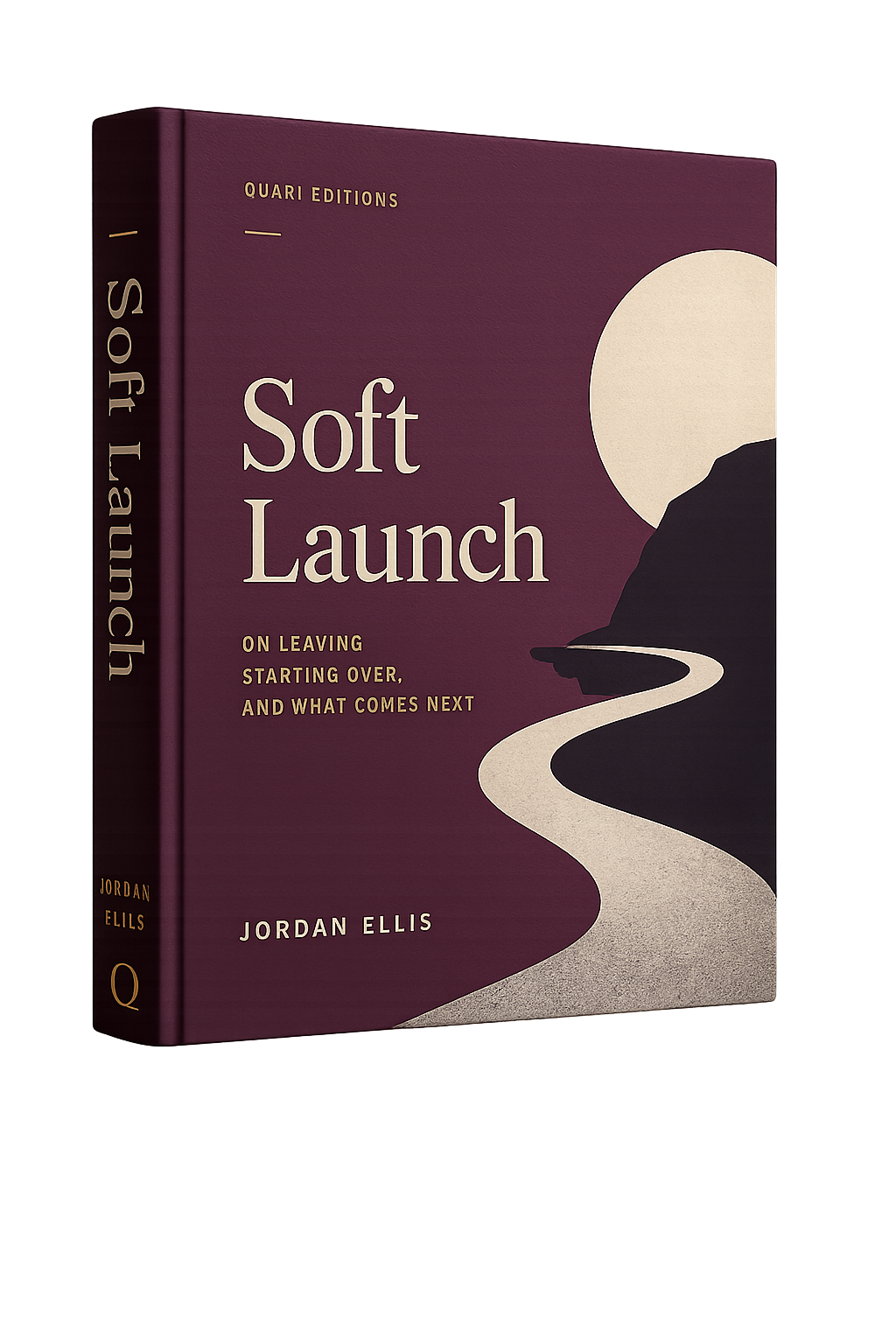
Soft Launch
On leaving, starting over, and what comes next
Jordan Ellis · Quari Editions · First Edition
We're told to make our exits loud. Burn the boats. Announce the pivot. Post the manifesto. But most real beginnings are quieter than that — a slow unclenching, a Tuesday that feels different, a door you close so softly no one hears it. Soft Launch is a collection of essays about leaving things: jobs, cities, versions of yourself you outgrew. It's for anyone standing at the edge of a change they haven't told anyone about yet, wondering if it's allowed to be this undramatic. It is. The quiet ones count too.
Sample reading
Introduction
There is a particular kind of change that doesn't make a good story. No rock bottom, no lightning bolt, no dramatic resignation thrown across a conference table. Just a slow accumulation of small wrong-feelings until one ordinary morning you realize you've already left, internally, and your body is just waiting for the paperwork to catch up.
These essays are about that kind of change. The soft launch. The version of starting over that happens before you've told anyone, sometimes before you've fully told yourself.
I left a good career the quiet way. I didn't have a better offer or a five-year plan or a single clever thing to say about it. I just knew, with the calm certainty of something long overdue, that I was done — and then I had to live in the long, undramatic middle between knowing and doing. That middle is where most of life's real turns actually happen, and almost nobody writes about it, because it doesn't photograph well. It's mostly waiting. It's mostly doubt. It's mostly fine, actually, in a way that's hard to explain to people who want your transformation to be inspiring.
If you're in that middle right now — if you've quietly decided something and haven't said it out loud yet — these essays are for you. Not to push you out the door. Just to keep you company while you stand near it.
I. The Last Monday
You don't know it's your last Monday until later. That's the thing about endings that arrive softly — they don't announce themselves. You make your coffee the same way. You take the same route. You answer the same emails in the same tone, and somewhere in the middle of an ordinary afternoon, you understand that you've already gone, and the going just hasn't been processed yet.
Mine looked like every other Monday for eight years. I want to be honest about how unremarkable it was, because the movies have lied to us about this. There was no speech. I didn't stand on a desk. I didn't finally tell the person who'd made those years harder than they needed to be exactly what I thought of them. I sat in the same chair, in the same gray light, and did my job competently, the way I always had, and the only difference was that I was watching myself do it from a small distance, the way you watch a house you used to live in from the street.
I think we romanticize the loud exit because it gives the leaving a shape. If you slam the door, at least there was a door, at least there was a moment, at least you can point to it later and say that's when it changed. The quiet exit denies you that. There's no moment to point to. There's just a gradual lowering of the temperature until one day you notice you've been cold for a while.
What surprised me most about my last Monday was the tenderness of it. I'd expected to feel triumphant, or terrified, or at least something with an edge to it. Instead I felt the way you feel at the end of a long trip when you're packing the last bag — not sad exactly, not happy, just done, with a soft ache underneath that's mostly gratitude wearing a coat. I'd given this place years. It had given me a salary, a routine, a version of myself I'd worn so long it had taken the shape of my body. Walking away from it wasn't a rejection. It was just the end of a fit that no longer fit.
I made a list, that last Monday, of things I'd miss. It was shorter than I'd feared and longer than I'd hoped. I'd miss the woman two desks over who laughed like a kettle. I'd miss knowing exactly what was expected of me, which is a comfort you don't appreciate until you trade it for the open, terrifying nothing of not knowing. I'd miss the version of competence I'd built here — the ease of being good at something, of walking in and knowing the answers. Starting over means giving that up. It means being bad at things again, in front of people, on purpose. Nobody warns you that the hardest part of leaving a place you've mastered is the return to being a beginner.
But I'd also made, without quite meaning to, a longer list — one I didn't write down because it lived somewhere below words. A list of the small daily deaths I wouldn't miss. The Sunday-night dread that started arriving by Saturday afternoon. The meetings that existed only to schedule other meetings. The slow realization, repeated a thousand times, that I was spending the one life I had being slightly bored in a comfortable chair. That list was the real reason. The quiet exit isn't quiet because nothing's wrong. It's quiet because what's wrong is so steady, so low and constant, that it stopped sounding like an alarm and started sounding like the room.
When I left that evening I didn't take a box. That felt too final, too cinematic. I took my coffee mug and left everything else, told myself I'd come back for it, and never did. Maybe that's the truest image of a soft launch I have: not a dramatic clearing-out, but a single mug carried home, and a whole life left behind on a desk for someone else to deal with, because you've already mentally moved into a future you can't yet see.
The next morning was a Tuesday. I woke up at the same time out of habit, made coffee in the mug I'd rescued, and sat at my own kitchen table in the gray light with nowhere to be. The fear I'd been promised didn't come, or didn't come yet. What came instead was stranger and harder to hold: a vast, quiet openness, like the silence after a song you didn't realize had been playing for eight years finally stops.
That openness is where the rest of this book lives. It's not comfortable. But it's honest. And after years of a comfort that wasn't, honest felt like the first real thing I'd touched in a long time.
— End of sample —
This volume was published with Quari — brief to bound book to storefront, in an afternoon.