
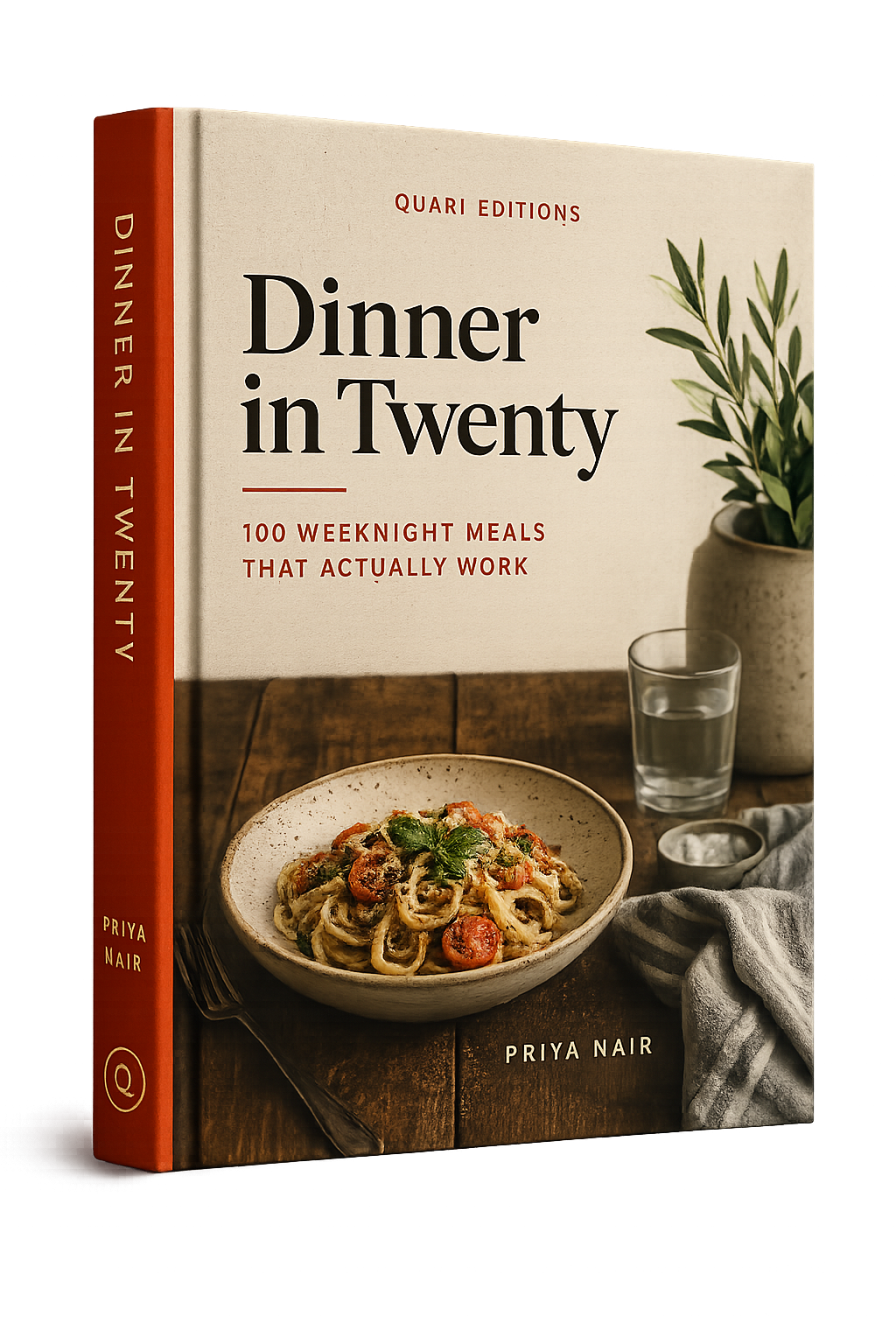
Cookbook
Dinner in Twenty
100 weeknight meals that actually work
Priya Nair · Quari Editions · First Edition
This isn't a cookbook about becoming a better cook. It's a cookbook about Tuesday at 6:45 when you're tired and the fridge has three things in it and you have twenty minutes before someone asks what's for dinner. Dinner in Twenty is 100 recipes that pass the only test that matters: they work, every time, with what you actually have, in the time you actually have it. No special equipment. No twelve-item ingredient lists. No instructions that assume you enjoy cooking more than eating. Just dinner, actually, tonight.
Sample reading
Introduction
The lie we've been sold about weeknight cooking is that it requires inspiration. That you'll open the fridge, see what's there, and feel a spark of creative possibility — oh, I'll make a quick Thai coconut curry with those leftover vegetables and the fish sauce I bought for a recipe I made once in 2019. This happens occasionally, for people with a particular kind of energy, and I am happy for them. For the rest of us, on the rest of our Tuesdays, dinner is not a creative act. It's a logistics problem.
I started keeping a serious record of what I actually cooked — not what I planned to cook, not what I photographed for the blog, but what actually ended up on the table — about three years ago. The results were humbling and clarifying. I made roughly forty dinners in any given season. About twenty of them were some version of the same eight or nine meals, adjusted for what we had. Another ten were things I'd made so many times I could do them mostly on autopilot. The remaining ten were experiments, half of which I never made again.
That's the real shape of weeknight cooking for most people, and nobody seems to want to say it: you have a repertoire, and the repertoire is smaller than you think, and that's fine. The goal isn't to cook everything. The goal is to cook the right things repeatedly until they take up no mental space at all — until Tuesday's dinner isn't a decision you make, it's just Tuesday.
This book is organized around that reality. The recipes here are not special-occasion food. They are not "impressive yet simple" in the way that phrase means impressive enough to photograph but simple enough that someone who has not actually tried it will believe the "simple" part. They are genuinely simple. Some of them are almost embarrassingly simple. I have included them anyway because they taste good and they take twenty minutes and that is the entire point.
The pantry chapter comes first because your pantry is the whole game. A well-stocked pantry means twenty-minute dinner is always available; a bare pantry means you're ordering pizza. I'll tell you exactly what I keep and why, without shame about any of it, including the fact that I keep five different hot sauces and consider this a character strength rather than a problem.
After that: the recipes. Organized loosely by method rather than by ingredient, because the thing you need to know on a Tuesday night is not "what can I make with chicken" but "what can I make fast" or "what can I make with one pan" or "what can I make without going to the store." The chapter breaks are practical, not aesthetic.
One rule I've held firm on throughout: every recipe in this book has been made by a real person, in a real kitchen, on a real weeknight, while real life was happening around them. Not a test kitchen. My kitchen, which has been in at least four different configurations over the years and has never once had good lighting for photos. If it worked there, it'll work anywhere.
Let's make dinner.
III. One-Pan Weeknights
The best thing about one-pan cooking is not what you'd think. It's not the cleanup, though the cleanup is good. It's that the pan makes the decisions for you.
When you're cooking in one pan, the order of operations is largely determined by the pan itself — what needs heat first, what will burn if you're not watching, what can come in at the end. You're not juggling three timers and a pot of pasta while also remembering to salt the water. You're just watching one thing, adjusting one heat, making one set of judgment calls. For weeknight cooking, that reduction of cognitive load is worth more than almost any other technique.
The recipes in this chapter are built around four pans: a 12-inch cast iron skillet, a sheet pan (standard half-sheet, the kind that fits in most ovens), a Dutch oven, and a large nonstick. You don't need all four to start — if I had to pick one, I'd take the sheet pan, because it's the laziest and most forgiving option, and laziness in service of dinner is a virtue I will defend.
Sheet Pan Chicken Thighs with Whatever's There
This is the recipe I make most often. It has no fixed form. The version I'm giving you here is the version I made last Tuesday, which happened to involve a half a head of cauliflower, some cherry tomatoes I needed to use, and a lemon that was getting old. Next Tuesday it will be something else. That's the point.
Serves 4, takes 20 minutes active
6 bone-in, skin-on chicken thighs 2 cups of whatever vegetables need using (see note) 3 tablespoons olive oil Salt, black pepper Whatever aromatics you have (garlic, shallots, onion, all work) Acid at the end (lemon, vinegar, a splash of white wine)
Heat oven to 425°F. While it heats, pat the chicken dry with paper towels — this is the step most people skip and it's the reason their chicken skin doesn't get crispy, so don't skip it. Season generously with salt and pepper on both sides.
Toss your vegetables with 2 tablespoons of the oil, salt, pepper, and whatever aromatics you're using. Spread them in a single layer on the sheet pan. Nestle the chicken thighs on top, skin-side up. Drizzle with the remaining tablespoon of oil.
Roast for 35 minutes, until the skin is deeply golden and the juices run clear. Don't open the oven before 30 minutes — the heat drop isn't worth it. When it comes out, squeeze lemon over everything or splash with a bit of vinegar. The acid lifts it from good to genuinely good.
That's the recipe. The variations are infinite. Chicken thighs with root vegetables in winter. With asparagus and cherry tomatoes in spring. With zucchini and red onion in summer. With whatever half-used vegetables are making you feel guilty in the back of the crisper drawer right now. The cooking time adjusts slightly based on what you're roasting alongside — dense vegetables like carrots and potatoes can go in first and then be joined by the chicken; tender vegetables like spinach go in the last five minutes if at all.
Note on vegetables: Almost anything works. The only things I avoid are leafy greens (they go in at the end, if at all), beets (they turn everything pink, which some people love), and anything with very high water content like cucumber (it just gets sad). Everything else is fair game. Halve or quarter anything larger than bite-sized; leave smaller things whole.
Skillet Eggs That Aren't Just Scrambled Eggs
The skillet egg situation is underrated as weeknight dinner. I know there's an instinct to feel like eggs aren't dinner — a holdover from some idea that dinner has to be substantial and meaty and, above all, take a long time to make. This instinct is wrong and I have no patience for it. Eggs are dinner. Eggs are good dinner.
Serves 2, takes 12 minutes
4 eggs 1 cup of any tomato situation (canned diced, crushed, leftover sauce, jarred marinara — all fine) 1 small onion, diced, or 2 shallots, or 4 scallions 2 cloves garlic Olive oil Salt, red pepper flakes Any soft herbs you have (parsley, cilantro, basil — all work) Crusty bread for serving, ideally
Heat a 10-inch skillet over medium heat. Add enough oil to coat the bottom, add the onion, cook until soft, about 4 minutes. Add the garlic, cook 1 minute. Add the tomato, season with salt and red pepper flakes, let it simmer for 3 minutes, stirring occasionally.
Make four wells in the tomato mixture with a spoon. Crack an egg into each well. Cover the pan and cook until the whites are set but the yolks are still a bit runny, about 3–4 minutes. You can go longer for fully set yolks; some people prefer it.
Scatter herbs over the top. Eat directly from the pan with bread for scooping. This is one of those recipes that requires no plating and is better for it.
The variations here are also many: add feta before the eggs, or a handful of wilted spinach, or some sliced olives. Use a green sauce base instead of tomato. Add leftover roasted vegetables to the tomato mixture. What you're really making is a structure — a flavored, warm base for eggs to cook in — and the specific flavors are yours to decide.
— End of sample —
This volume was published with Quari — brief to bound book to storefront, in an afternoon.